Do you blend your own mixtures for diffusers, create home oil perfumes or roll-ons, but the result often doesn’t match your expectations? Sometimes the scent evaporates before you even manage to sit down in your armchair, other times it feels heavy and flat, even though you used the highest quality ingredients. The problem is often not in the quality of the oils, but in the way you combine them. For your fragrant creations to have depth, develop beautifully, and last longer than a few minutes, they must have a solid structure. This structure is called the olfactory pyramid.
What is the olfactory pyramid?
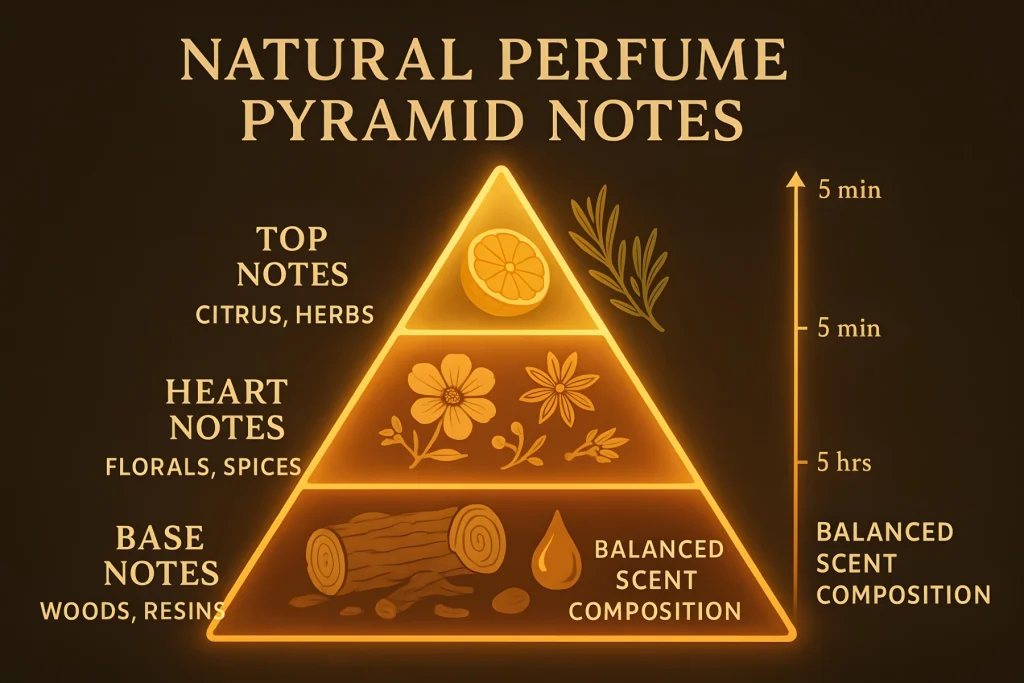
Imagine a perfume or a diffuser blend as a building. To be stable and complex, it needs strong foundations, a load-bearing structure, and a roof. In perfumery terminology, these three levels are called Head (Top), Heart (Middle), and Base (Bottom). This division is not just poetic, but is based on the volatility of individual essential oils, i.e., how quickly their molecules evaporate into the space.
Let’s break down the individual levels of this imaginary pyramid.
1. Head (Top Notes) – First Contact
The Head represents the lightest and fastest evaporating notes. It is the scent you smell immediately upon opening the bottle or after the first spray of perfume (after the alcohol evaporates). Its task is to captivate, refresh, and provide an immediate impression.
Character: Light, fresh, energetic, highly volatile.
Longevity: Smells intense but brief. Usually dominates the first 15 minutes, depending on the oil type, it can be noticeable up to 2 hours.
Which essential oils belong here:
Most Citrus: Orange, Lemon, Bergamot, Grapefruit, Mandarin
Fresh Aromatic Herbs: Mint, Lemon Balm, Eucalyptus, Basil, Lavender, Thyme, Tarragon
Some Floral Oils: Neroli, Mimosa
Some Spicy Oils: Black Pepper, Ginger
Some Woods (mostly Conifers): Pine, Cypress, Juniper, Rosewood
Pro Tip: If you need an immediate boost or quick air freshening, reach for oils from the “Head” category. However, they evaporate quickly in a diffuser, so it is advisable to “anchor” them with oils from the lower levels of the pyramid if you want the scent to last longer in the room.
2. Heart (Middle Notes) – Character of the Scent
Once the initial intensity of the head fades, the heart sets in. It is a significant component that gives the perfume or blend its true identity and character. The Heart forms a harmonious transition between the light introduction and the heavy base. Without it, the scent would feel disconnected and flat.
Character: Full, harmonizing, often floral or spicy.
Longevity: Fully develops usually after 20–30 minutes from application and lasts for 4 to 6 hours.
Which essential oils belong here:
Floral Oils: Magnolia, Jasmine, Frangipani, Ylang Ylang, Tuberose, Rose, Iris, Mimosa, Violet, Osmanthus
Spicy Oils: Cinnamon, Clove, Cardamom
Some Herbs: Sage and Clary Sage, Geranium, Rosemary, Lemongrass, Palmarosa, Litsea Cubeba, Roman Chamomile
Pro Tip: The Heart is key for the emotional impact of the blend. It is here that we find oils that influence mood most significantly: rose for opening emotions, lavender for calming (often stands on the border of head and heart), or cinnamon for a feeling of warmth and safety.

3. Base (Bottom Notes) – Depth and Fixation
Base notes are the heaviest, least volatile, and last the longest. They form the essence of the perfume itself and act as a fixative – holding the lighter molecules from the head and heart so they don’t evaporate so quickly. The Base is what you smell in the room even after several hours, or on clothes even the next day.
Character: Heavy, earthy, woody, balsamic, sweet.
Longevity: They set in very slowly but persist on the skin or in the space for 6 or more hours, in some cases (on clothes) even days.
Which essential oils belong here:
Woody Oils: Cedarwood, Sandalwood, Palo Santo
Resins: Frankincense, Myrrh, Peru Balsam
Earthy Tones: Patchouli, Vetiver, Helichrysum, Calamus, Rock Rose (Cistus)
Exotic and Sweet Tones: Vanilla, Benzoin
Pro Tip: If you want a blend for meditation, deep relaxation, or quality sleep, choose oils from the base of the pyramid. These scents tend to ground and calm us.
How to use the pyramid when blending?
When creating your own blend for a diffuser or home perfume, try to represent all three levels. This will ensure that the scent has its development and does not feel monotonous.
To start, you can try the ratio:
30% Head : 50% Heart : 20% Base
Example of a balanced composition:
Orange (Head) – adds joy and lightness
Cinnamon (Heart) – adds warmth and character
Frankincense (Base) – adds depth and ensures the scent doesn’t evaporate immediately
In the base category, we often find Absolutes (e.g., Vanilla). These substances, obtained by a method other than steam distillation, are often thicker and richer in scent. It is they that add that professional, “perfume-like,” and luxurious touch to compositions, which you cannot achieve with ordinary citrus oils.
Knowledge of the olfactory pyramid will allow you to better select oils and create blends that will not only smell beautiful but will also have the desired intensity and longevity.
Explore our range of essential oils and Absolutes and try to build your own scent pyramid.